Notas/Notes
 Question
There seems to be two different art worlds
Zygotic Acceleration and GFP Bunny: Different aesthetics strategies?
1-Object of Study
0.0 Questions, Intro to the problem, Rationale
1.1 Contextualization of individuals
1.2 The Objects of study
2- Aesthetic Strategies
2.1 Zygotic and "in your face"
2.2 Kac and the process
2.3 Artists' ethics and morals
(1)
- Do an introduction about genetic engineering on the past 10, 20 years (Use example found in literature - Island of Dr Moroe + more popular examples)
- Genetic engineering and new forms of life ethical implications
- Morality on relation to science(?)
--------------------≠-----------------------
The image of the works opening part 2
(2)
Two different strategies, two different art worlds (Reasons for choosing both artists: Age (1966, 62); Different careers; No consensus regarding their work)
Kacs' GFP Bunny / Chap Zygotic
1st Description / Description
2nd Artist word about his work / Artist word about his work
3rd The critique / The critique
Characteristics:
Conceptual / Shocking Aesthetics
Interactive (action/reaction) / Observational
academic / popular
Experimental in relation to technology / Conservative in relation to...
Notas/Notes
 Different and conflicting? Social critique on Kac and Chapmans B works.
-Which ones are the system of legitimization?
1st Comparison between A and B (A=Tradicional; B=New; C=Popular?)
2nd Draw a comparison between 2 artists
Period: Actual, Contemporary
-Which strategies are adopted by Kac and Chapmans?
-Which is the aesthetic difference between both works?
Zygotic Acceleration and GFP Bunny: Different Strategies
-Which is the difference between the critique directed to both A and B?
-Which is the artistic intention on both works?
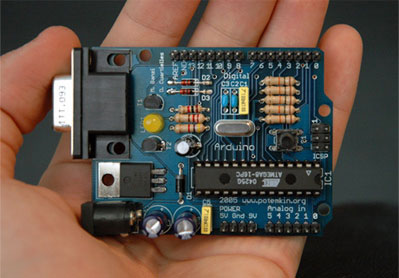 For those who do not know Arduino, here is a picture of it.
According to its website, the Arduino board:
"is an open-source physical computing platform based on a simple i/o board, and a development environment for writing Arduino software. The Arduino programming language is an implementation of Wiring, itself built on Processing."
Despite its low price (22.00 EUR), its main quality lies on the fact that it can be expanded and controlled by a series of softwares and hardwares.
Great value for money ;)
Teoria/Theory
Different forms of Conceptual Art: Ars Systematis
1 Strategies
This project, Ars Systematis, aspires to work with “interactive metaphors” as a way of communicating by non-visual means ideas or concepts 1. Different from conceptual art per se, where concept is expressed by textual, formational or pictorial means, Ars Systematis searches for a form of interaction between observer and concept; a hermetic system where “action” leads to “reaction”. In other words, creating a different approach to the dated conceptual art and its current manifestations; an art form obsessed with avant-gardism’s and the old art for arts’ sake (Ars gratia artis).
The purpose of this art form, the conceptual art, is to communicate a concept or an idea. However, with the latest brand of avant-garde, concept is secondary to the image. Moreover, avant-garde based on the assumption that we should have our senses challenge by new forms of representation, usually defined by visual aesthetic forms, concept is not only less important than the art object, but also a gimmick (Stallabrass. 1999: p103). Consequently, we should communicate in a different way and not fall on the same repeated strategy of visual transgression.
This non-visual, but rather sensuous conceptual representation arises from some observations related to the nature of art itself 2. Despite the claims of “the end of art”, the art world, its market and its exhibitions thrive as a whole (Artprice. 2006). Yet, art and its theory seems to be for the past two decades criticized by both public and critics as a fetish and commercial activity. (Burgin. 1986; Stallabrass. 1999). Etymologically, the word “art” derives from the Latin word Ars, originally used to define ways and methods of doing and executing something. The original concept, however, is transformed during the Classical period when Ars becomes Art as a unified and hierarchical sphere that, until now, became our traditional understanding of art per se. (Rancière. 2004). Conceptual Art and some of its forms, however, seems to confront in many ways the traditional conception of art (Stallabrass. 2003). Yet, the intention of this project is not to analyze why or how art became entangled on the battle between pessimists and fetishists. Instead, we should rethink on an art form that could be representative of our current ‘information society’ (Castells. 1996).
Regarding its medium, Ars Systematis will focus on the qualities of new media. Being extremely related to our current way of production (Castells. 1996), one could even think on the possibility that new media or digital media not only relates, but is also possible by our time in history. Choices and possibilities are immense. In a practical sense, no other medium can afford the necessary interaction between idea/concept and observer (We will, later on this text, see the practicalities of this choice). Furthermore, some new media qualities implement Conceptual Art. In a comment on Manovich (2001: p226-7), Stallabrass says that:
“The break from the aesthetics of the isolated art object and the move towards an art of discursive process that was begun by Conceptual Art could be completed online where provisional, ever-changing character of material is taken for granted. As Manovich puts it in his meditation on the database form, historically, artists made unique objects in particular media in which interface and content were inseparable (and in the assimilation of Conceptual Art, we may say that they congealed) In the new media, the content of the work and the interface are separated; a work in new can be understood as the construction of an interface to a database (Stallabrass. 2003: p27)”.
2 Technicalities
Decided the medium appropriate, we should now concentrate on the practical aspect of this project. In order to achieve interactive metaphors or interactive concepts we should have an environment where an observer acts on a concept. This event is just worthy if the concept per se would react this interaction between observer and concept. As commented above on this essay, in other to escape the adversities of visual representation, we should focus on other channels of communication. In first instance, sound seems to be an appropriate form of interaction. Its availability in many digital devices and its familiarity with humans’ most basic form of communication, gives sound the advantaged in being available, familiar and non-visual.
On the simple level of interaction (action/reaction), closed, hermetic systems necessarily convert any action in reaction. Many examples of similar systems already exist, in the digital realm, and are called programs. Recently, new programming languages made possible for artists to engage with new media. Therefore, not only relying on off the shelve software but opening the possibilities for the artist own software. In its most clear examples of possibilities we have Pure Data or PD 3 and Processing 4. Those two platforms are both free of charge and the result of collaborative work. They also contain a vast library of reference for their respective software and hardware, something especially useful for inexperience users when it comes to learning their languages and procedures. In order to capture data from the observers’ interaction, we could cite a long list of examples of simple digital devices that can be connected with the artist software: Infrared sensors; ultrasound sensors; digital cameras; accelerometers; potentiometers; LDR light sensors; NTC heat sensors…Finally, its important to note that the outcome of this project is a pure experimental art form, both theoretical and methodological. We might achieve a different form of conceptualism, both in theory and practise. It might be that we have a performatic act rather than a perceptual one. Any early conclusion is mere speculative.
Notes
1 Despite the fact that many of his points could be challenged, in his ‘Sentences on Conceptual Art’, Sol LeWitt gives a clear definition between concept and idea, where ‘The former implies a general direction while the latter are the components. Ideas implement the concept.’ (1969 cited in Harrison and Wood. 1992: 850)
2 However, this project does not attempt to reconcile art and its favourite last subject, art for arts’ sake. It is clear that the quest for art sphere limits became irrelevant once all subjects are equal; a priori there is no reason for exploring different paths. This is a comment that derives from the observation of the aesthetic regime of the arts as described by Rancière (2004).
3 His developer, Miller Puckette, describes Pure Data as being
“designed to to offer an extremely unstructured environment for describing data structures and their graphical appearance. The underlying idea is to allow the user to display any kind of data he or she wants to, associating it in any way with the display (Puckette 2004).”
4 Started in 2004 by Ben Fry and Casey Reas, Processing aims to:
“teach fundamentals of computer programming within a visual context and to serve as a software sketchbook and professional production tool. Processing is developed by artists and designers as an alternative to proprietary software tools in the same domain (Processing.org. 2006)”.
Bibliography
Artprice. (2006), Art Market Trends 2005, (Internet), Artprice.com, Available from http://img1.artprice.com/pdf/Trends2005.pdf (Accessed 20 November, 2006)
Burgin, V. (1986), The end of Arts Theory, London: Macmillan Press
Castells, M. (1996), The Rise of the Network Society: The Information Age: Rise of the Network Society Vol 1, 2nd ed. London: Blackwell Publishers
Harrison and Wood. (1992), Art in Theory 1900-2000, 2nd ed. Blackwell Publishing
Manovich, L. (2001), The Language of New Media, The MIT Press
Processing. (2006), (Internet), Processing.org, Available from http://www.processing.org (Accessed 27 November, 2006)
Puckette, M. (2004), Using PD as a score language, (Internet), University of California, San Diego, Available from http://www.crca.ucsd.edu/~msp/Publications/icmc02.dir/icmc02.html (Accessed 19 November, 2006)
Rancière J. Trans Rockwill, G. (2004), The Politics of Aesthetics, London: Continuun
Stallabrass, J. (2003), Internet Art: The Online Clash of Culture and Commerce, London: Tate Publishing
Stallabrass, J. (1999), High Art Lite, London: Verso

 The Arduino playground web page has a collection of tutorials and examples of how to control its Arduino sensors with a variety of softwares. Extremely useful.
These images show the GUI and the PD object for its PD version. Arduino Playground also has a collection of links and some images for electrical work related to the physical connection of components.
Teoria/Theory
Ars Systematis
ars N 3 3 NOM S F
ars N 3 3 VOC S F
ars, artis N F [XXXAO]
skill/craft/art; trick, wile; science, knowledge; method, way; character (pl.);
systemat.is N 3 2 GEN S N
systema, systematis N N [FXXES] Medieval uncommon
system; complex whole; whole consisting of several parts; harmony (Latham)
Aims
This project aspires to work with “interactive metaphors” as a way of communicating by non-visual means. In other words, creating a different approach to the dated conceptual art; an art form obsessed with avant-gardism’s and art for arts’ sake (Ars gratia artis)
Objective
The purpose of this art form, the conceptual art, is to communicate a concept. However, with the latest brand of avant-garde, concept is secondary to the image. Moreover, traditional avant-garde is based on the assumption that we should have our senses challenge by new forms of representation, namely visual aesthetic forms. In this scenario, concept not only is less important but also a gimmick. Thus, we should communicate in a different way and not fall on the same repeated strategy of visual transgression.
Rationale
Despite the claims of “the end of art”, the art world, its market and its exhibitions thrive as a whole (Artprice 2006). Yet, art and its theory seems to be for the past two decades criticized by both public and critics as a fetish and commercial activity. (Burgin 1986; Stallabrass 1999). The intention of this project, however, is not to analyze why or how art became entangled on the battle between pessimists and fetishists. Instead, we should rethink on a art form that could be really representative of our current “Information Society” (Castells 1996)
Method
This project aspires to rethink the forms of thinking and producing art. Etymologically, art derives from the Latin word Ars, originally used to illustrate ways and methods of doing and executing something. The original concept, however, is transformed during the Classical period when Ars becomes Art as a unified and hierarchical sphere (Ranciere, Jaques 2000). Thus, we should explore this transformation (and consequently its implications for our current period) on the light of the distribution of the sensible and Rancieres’ theory of politics (Ranciere, Jaques 2000).
Outcomes
The outcome of this project is a pure experimental art form. We might achieve a different form of conceptualism, both in theory and practice. It might be that we have a performatic act rather than an object. Any early conclusion is mere speculative.
Media
PD or Processing connected to external sensors.
 This website has extremely helpful tutorials to connect many different sensors on to Arduino boards.
Its bassically prepared for processing rather than PD. However, tutorials on the same operation for PD can be found at another address.
The images shows a ultrasound sensor being connected to Arduino. This sensor emits a pulse wave that "pings" on the input of the software (PD or Processing). The closer a object is from the wave source, the quicker is the "ping"
A simple technique that could have many applications on interactive art works.
Notas/Notes
 For the work (MA Forum)
The Building of Knowledge (one of Digital Arts qualities)
Construction, the music (Chico Buarque),
Relation with the aesthetic beauty of the system
and, on this specific case,
its use as critique.
In my point of view,
this beauty is the same of theories and math, physics...
The predictability and
MADA
1st Aesthetic of the System
2nd Accumulation of thought/knowledge
Think on the movie:
1-Black and White text with its translation
2-The Text being written by the hand
Knowledge/Power
Not only that work with the book is important (last post) as a metaphor of Kn/Po, but is also important by its question of arrival/path. This path, hostile and difficult, leads you to the symbolized power of the book (Think if it is a cliché - Of course it is!) and at this moment, reading the book, the hostility stops. Thus, power belongs to the individual that trespassed this path.
Yet, another question:
is knowledge independent from the "will" of the person who owns it, the oppressor?
Could be this work done by the metaphor of the closed/open book?
Open book ON (High sound)
Closed book OFF (silence)
This could be another feature of the same metaphor Kn/Po (TO THINK!)
Notas/Notes
 Meeting:
+Look for Lev Manovich
+Janet H. Murray (look at her idea of immersion)
Agency Idea (relationship between observer and art piece)
+Start blogging
---------------≠---------------
Project: The long path to power
Distance "x" is inverse proportional to the sound.
Vision from the top
Approximating the object, the one that searches power will be "attacked" (sound) by knowledge. Once inside the sphere of "power" (y) the one who searches for power will have the "word".
Notas/Notes
 ----------------≠---------------
≠2 Scream (The same idea that I had thought before)
On PD or Processing:
A
if {voice input > 50Hz (Amp?)}
B
if {voice input < 50Hz...
Human Repealer
When someone would get at less than 5m the cornet would buzz, creating a sonic barrier aggressive to humans.
The cornet buzz is proportional to the distance between individual/object
---------------≠---------------
LCD cloth...

Bizarre product. It may be usefully.
Notas/Notes
 (continuation) For example, a individual with amnesia could explain his/her culture. Yet, not his/her personal values (?)
----------------≠-----------------
Idea: Use photosensitive and transparent paint (in powder?) to create small images that appropriate shadows made by the street objects (lamp post, garbage bean, cars - Giving preference to "statics" images?)
Static shadows would be stationary objects.
2nd Idea:
Could plants be injected or sprayed by the powder? (Aluminion something...)
---------------≠------------------
Look at the net:
Journal of Memeties
Memetics
--------------≠-------------------
Notas/Notes


Average: A sculpture of data in a 3D process:
1st Capturing data
At each new photography the software would make the transformation between different faces; combining them. However, the combination should be done with a certain delay, this way being slow and gradual.
----------------≠--------------
Theory:
Because culture "evolves" like a gene, we have the environment as the main source of transformation and adaptation. This would explain why certain "terrible" ideas proliferate on (next page) cases in which the environment changes dramatically.
The Lord of the Flies could be an example (explain,
ANALYZE AND QUESTION!
--------------≠---------------
Would be culture itself a organism?
The fact that culture is acquired by "learning" by the individual could represent the non-specialization of body cells' on the formation of the human body.
If the evolutionary culture theory is right we could draw the genealogical tree of a culture. Analyzing if the environment correspond to certain culture would explain the logic (if any) of cultural adaptation (Analyze the relation between "cultural traits" and environment).
------------≠-----------------
Art: Is it the best art piece the one that metaphorically (symbolic?) represents our culture?
-----------≠------------------
Thus, any analyzes of culture that does not concerns the agent that defines it -the environment- is useless.
-----------≠-----------------
Could amnesia explain (next page) something?
Notas/Notes
 --------------------------------
The critic (Software {1st part} and Hardware {2nd part-2D} project)
The project should be done on 2 parts.
The 1st, constitute the software. Including its full operational version on the web.
The 2nd, the Hardware, is the critic itself. This should include software (its mind) that should receive information and process it on real time.
The soft should analyze patterns between images (1) and text (2).
(1) The pictorial analyzes should include: Pixel pattern; Contrast; Colour levels; Lines (see algorithm - similar to the one on photoshop); Symmetry...
-----------≠-----------≠---------------
Good idea. However, it would take a decade!
Remember that the critic at this work is a conceptual critic. Hence, not the current critic, the metaphysical.
Another difficulty is the semantic critique. How software would recognize the "symbolic value of pixels"
Notas/Notes
 (1) For the web with quicktimeVR:
The world. My bedroom in 3D. With the possibility to travel trough this world.
A VIRTUAL INSTALLATION
(2) Low Tech Technology
Create 'gadgets" that promises to be the salvation of many problems of modern life. Thus, questioning our obsession with technology
and mine,
------------≠------------
Notas/Notes


Project for the NetWe want...
(many languages)
A questionnaire to be done on the web.
Try to collect the highest number of individuals from the world.
The website becomes a collective voice of the world - a world wide ethics
Analyzing (and publishing) the data in statistic and quantitative way we would have a graphical representation (different interfaces?) of such information (which ones to publish?).
We are not interest in a dialectic interpretation of the information.
Maybe? yes because the dialectic is universal (?)
Neither we are interested in judge (the motifs and the voices) this collective voice.
The intention is to record, archive and transform this information on history. This is a never ending and continuous work. The human ambitions in a web page.
(1) How is it the questionnaire
(2)How would be done the database
(3)Should I use (or utilize) market rules (economy)?
(4)How would be the design?
(5)Open Source? Java? HTML? Mysql?
Notas/Notes
 -Plain
-Text
-
IMPORTANT:
Prepare proposal for MA research
---------------------------------------
Another thing for comedy and art
1-Use Mac voices to create sitcom/podcast.
Each voice is a character
2-Use voice to narrate "Tuesday" (Tuesday V2.0)
The term "tuesday" becoming only a variable. It could be changed by anything.
 Question


