18.4.08

Collaboration/Colaboraçao/Colaboracion

Link

"Londiniensium is a film that came out of an investigative project conducted by myself based upon hypothetical inquiries about open- authorship and free-form narrative. It is a participatory film project that draws upon the reference of Laurence Lessig’s (founder of Creative Commons) philosophical questions about ‘user generated content’ as a definitive characteristic of contemporary culture (e.g. Creative Commons, Open-source, Wiki-technology etc). The film was shot over a period of four months from Nov 2007 to February 2008."

Newnononuevo in collaboration with Himanshu Desai, director of the project Londiniensium, has prepared some posters for its' screening. The film will be shown at CSM, summer 2008. Exact dates comming soon.

Newnovonuevo em colaboração com Himanshu Desai, diretor do projeto Londiniensium, preparou alguns posters para sua exibição. O filme será exibido no verão deste ano na CSM. Data e horário serão confirmados logo.

16.4.08

¸Ω dominação planetária


¸Ω world domination

News from abroad:

" anunciamos mais um passo na dominação planetária, no plano napoleônico de dominação do +zero: agora temos um quinto integrante oficial. trata-se do sr. german alfonso nuñez canabal adaid jr. brasileiro residente em londres, onde pesquisa tranqueiragens digitais em seu phd pela university of the arts london. pdc! "

we announce another step in the quest for world domination; +zeros' napoleonic plan of domination: we now have a fifth official member. mr german alfonso nunez canabal adaid jr. brazilian born he is resident in london and researches digital paraphernalia on his phd by the university of the arts london. pdc!

12.7.07

Trabalho/Trabajo/Work


It would be fair to say that The Nature of Speech is a classic installation. After all, we can all recognize a space composed for a certain kind of environment; one carefully planned to incite some very specific reaction from its’ viewers. Similar to many installations, this artwork belongs to conceptualism. It does not necessarily depicts an image or its’ abstraction. Aesthetics are an important element, but its primary concern, quite literally, is concept.

By looking closer, however, the picture seems to be blurred. In this type of artwork, concept is not just represented or aroused from static aesthetic features. Instead, by being immersed in an active environment observers can instantly recognize the basic messages of the artwork. This exact feature also represents an incompatibility with that usual conceptualistic characteristic: contemplation. When a person is “attacked” by sound, the message is clear. This cognitive process is accelerated by our own personal experience- good or bad.

The Nature of Speech has a clear subject, described on its’ own name. Speech’s relation with Knowledge and Power are, in effect, represented at the space. At this work, Speech and Knowledge are actually the same. Both also result in the same fate: Power. Consequently, this is the very same relationship that is experienced by an observer caught in this drama. Objects, sound and space acting as purely abstract ideas.

Despite those plain features, some other secondary but important statements are made on the artwork. On its’ own reality, The Nature of Speech has only one speaker. This character controls all, speech and knowledge. In this scenario, power is just a mere consequence. All other observers are subject to this person. Power will be exercised on them as long as the speaker desires. Try to face it, and suffer the consequences.

I wonder what could happen in this scenario. The stage, in principle, is set. What now? Benevolent speakers? Passive crowds? Rebellions?

28.6.07

Notas/Notes

The Contextualization of Ars Systematis

3-Conclusion

Throughout this essay many characteristics, both formal and theoretical, differentiated one artwork from another. Informed by the observations previously made, this third and last section will assemble a brief comparative table that, hopefully, will help on the conclusion of our exercise. First of all, however, we should clarify the rationale, the methodology and the terminology employed by this last section. The fact that many terms and concepts employed by the research are drawn from semiotics may cause some confusion. It is important to note that this study does not share semiology’s target; therefore, it is not interested on analysing the cognitive process evolved from the interaction between observer and artwork. Our main intention always has been the contextualization of The Nature of Speech among its’ contemporary peers. Consequently, we concentrate our efforts on the most fundamental mechanism shared by all new digital media artworks: information process and its’ representation. New digital media used as a platform and not as a tool, is at the same time the cause, justification and support for such system. Inherited from new digital media logic and purpose, the system is therefore central to all artworks seen on this text. Now, if the system itself is a common denominator, the same cannot be said about its’ components: input, process, and output.
These building blocks could be defined as:

Input – The information received by the system.
Process – The logic in which information is transformed from input to output. This process can evolve on two ways: Cyclical and Linear. A cyclical process does not accumulate input information over time; a linear process, on the other hand, does.
Output – The information transmitted by the system

These units offer the possibility to objectify our comparative analyses. Their recurrence in all digital media artworks makes them ideal for such study. In addition to these three components, Observer and Subject complete our table. By looking at the observer we expect to identify his position in relation to the artwork system. On the other hand, looking at the artwork subject we are informed of its’ content and concern.


Reading Black Shoals description at the table we realize the importance of its’ passive observer and liner system; it consequently becomes clear that this artwork offers an experience parallel to that of cinema. On the other side of this spectrum, however, The Nature of Speech and Volume present the observer with an action/reaction system. This observer does not passively appreciate a linear narrative; instead, it sees their movements being instantly translated into the artwork respective output.
In relation to The Nature, we can see that the artwork most similar in its’ strategies is also the only artwork that comments on itself. This fact, however, is not just pure coincidence. In order to achieve its’ interaction between body movement, sound and light, Volume had to conform to an cyclical system; at least, from the point of view of an observer, this system can instantly respond at any change in input.
The most interesting observation, however, comes from our last artwork, Eduardo Kac’s Genesis. Despite not achieving the same level of similarity found between Volume and The Nature, Genesis is certainly the artwork most aligned with my own practice. If observed carefully, its’ subject is almost identical to that of The Nature. Speech is just a form of information output; it always transmitted by coded information in the form of sound. While Kac’s artwork refer to the whole system of information, The Nature focus on just one form of output. Of course we know that speech, a particular form of output, is much more than simple information. In our society speech is also power; and it is our relationship with this power that is dealt in The Nature. In addition to this semantic relation, both Kac and myself share an interest on method and research as a form of artistic practice. Always informed by Kac’ texts and theory, Genesis is part of a larger project called Transgenic Art (Kac. 1998 internet accessed). Therefore, realizing that The Nature of Speech also works within a larger project, Ars Systematis, does not surprise one.


Bibliography


Clastres, P. (1977), Society Against State, Oxford: Basil Blackwell

Druckrey & Ars Electronica. (1999), Ars Electronica: Facing the Future, The MIT Press

Hartnett, G. (1996), Leonardo Music Journal – Editorial, The MIT Press

Manovich, L. (2001), The Language of New Media, The MIT Press

Manovich, L. (2002), Data Visualisation as New Abstraction and Anti-Sublime, (Internet), Available from: http://www.manovich.net (Accessed 10 April, 2007)

Murray, J. (1997), Hamlet on the Holodeck: The Future of Narrative in Cyberspace, The MIT Press

Nunez, A. (2006), Ars Systematis, Project Proposal, unpublished

Osthoff, S. (2001), Eduardo Kac's Genesis: Biotechnology Between the Verbal, the Visual, the Auditory, and the Tactile, (Internet), Available from: http://www.ekac.org/osthoffldr.html (Accessed 20 April, 2007)

Portway & Autogena. (2001), Black Shoals Stock Market Planetarium, (Internet), Available from: http://www.blackshoals.net/project.html (Accessed 10 April, 2007)
Kac. (1998), Transgenic Art, (Internet), Available from: http://www.ekac.org/transgenic.html (Accessed 20 April, 2007)

Kac. (1999), Genesis, (Internet), Available from: http://www.ekac.org/geninfo2.html (Accessed 20 April, 2007)

Kac. (1998), Transgenic Art, (Internet), Available from: http://www.ekac.org/transgenic.html (Accessed 10 April, 2007)

Stallabrass, J. (2003), Internet Art: The Online Clash of Culture and Commerce, London: Tate Publishing

Stallabrass, J. (1999), High Art Lite, London: Verso

Stocker & Schopf. (1999), Preface for Ars Electronica: Facing the Future, The MIT Press

United Visual Artists. (2006), Volume, (Internet), Available from: http://www.uva.co.uk/index.php/archives/49 (Accessed 15 April, 2007)

Wilson, Stephen (2002), Information arts: intersections of art, science and technology, The MIT Press

The Contextualization of Ars Systematis

2- Similarities

The project takes the form of a darkened room with a domed ceiling upon which a computer display is projected, like a planetarium. Audiences are immersed in a world of real-time stock market activity, represented as the night sky, full of stars that glow as trading takes place on particular stocks (Portway & Autogena. 2001 internet accessed)

Black Shoals Stock Market Planetarium (2001), an art project created by Joshua Portway and Lise Autogena, is a clear example of a new digital media artwork. Always dependant on information – in this case the constant movement of capital - Black Shoals follows the same mechanism that our artwork The Nature does: Information is organized by the artwork system and, consequently, represented by its’ mediums. Media theorist Lev Manovich believes this same mechanism has a special importance. Such is the importance that a concept was created around the same act: info-aesthetics. Manovich’s aesthetics “refers to various new contemporary cultural practices which can be best understand as responses to the new priorities of information society: making sense of information, working with information, producing knowledge from information” (2002 internet accessed).
Even though they share a common internal mechanism, Black Shoals and The Nature completely disagree on the terms trough which information is processed and represented; in other words, they differ in both their input and output. Originally informed by the artwork original idea, concept and/or intention, both (information) process and representation have unique variations: On one hand, Black Shoals is fed by a huge database whilst its’ observer contemplates a motion picture; The Nature, on the other hand, is informed by the spatial position of its’ observer/participants that, in turn, are subject to sound waves.
Ironically, from the point of view of its’ observers, the most compelling difference between these artworks is actually their own position within it. The difference is obvious. Portway and Autogena’s project relies much of its’ experience in sight and contemplation. Safe as an observer, you are not involved in the general system of the artwork – information process and its’ representation. Proposing the exact opposite, The Nature of Speech involves the observer while it simultaneously shapes the information process. However, an individual observer, at this situation, does become much more than a mere vehicle for information. These observers also become responsible for a perceptual common space, shared by all observers and affected directly by their own action.
In a recent show at the Victoria and Albert Museum, London, a “ sculpture of light and sound” (United Visual Artists. 2006 internet accessed) designed by the corporation like group, United Visual Artists, also focused itself on how to promote an action/reaction system between observer and artwork. Consequently, Volume (2006) “responds spectacularly to human movement, creating a series of audio-visual experiences” (United Visual Artists. 2006 internet accessed). Presenting and using the exact same method founded in The Nature, Volume’s observer/participant is given no choice but to interfere with the information process. This act, in return, affects the common space shared by all observers. Volume’s emphasis on its’ own feedback system, however, hides some of its’ real concerns as an art piece. When compared to both The Nature and Black Shoals, Volume seems to be a purely aesthetic endeavour; it does not comment on anything other than its’ own qualities.
Such an idea and rationale is extremely linked to the modernist period. Others have pinpointed this same relationship between new media art and modernistic thought (Stallabrass. 2003 p26; Stocker & Schopf. 1999 p14), tracing media art development back to the experimental work of many “isms”. Despite its’ main medium, new digital media, Volume is closely related to that ideology of the avant-garde which prevailed for most of the twentieth century; aesthetic experience is, therefore, its’ main concern. There are plenty of new digital media artists that still follow this same line of investigation and practice. Yet, for the attentive reader, it is also clear that Volume’s apolitical position is not apolitical at all. The moment an artwork is classified or conceived as being a purely aesthetic object it is also the moment of its’ ideological enlistment. Such political phenomenon, however, does not concern this paper (For a clear introduction on the same subject, please read Ars Systematis, Phd Proposal).
At this point it is important to stress that, despite varying immensely in content (concept), input and output, all three artworks discussed in this essay share that same basic mechanism: information process and its’ representation. Perhaps this mechanism is new digital media own justification of existence. On this case, however, any artwork produced with this same medium would inadvertently inherent such mechanism. Paradoxically, our next contemporary does not use a computer to process and represent information per se. Instead, Eduardo Kac’s artwork, Genesis (1999), employs the ultimate system for processing and representing information: life itself. Genesis, in his own words, “explores the notion that biological processes are now writerly and programmable, as well as capable of storing and processing data in ways not unlike digital computers” (cited in Osthoff. 2001 internet accessed). Kac’s approach to subject and practice is, as usual, based on a complex but rather logic set of events and theories:

“The key element of the work is an "artist's gene", a synthetic gene that was created by Kac by translating a sentence from the biblical book of Genesis into Morse Code, and converting the Morse Code into DNA base pairs according to a conversion principle specially developed by the artist for this work. The sentence reads: "Let man have dominion over the fish of the sea, and over the fowl of the air, and over every living thing that moves upon the earth." It was chosen for what it implies about the dubious notion--divinely sanctioned--of humanity's supremacy over nature. Morse code was chosen because, as the first example of the use of radiotelegraphy, it represents the dawn of the information age--the genesis of global communication. The Genesis gene was incorporated into bacteria, which were shown in the gallery. Participants on the Web could turn on an ultraviolet light in the gallery, causing real, biological mutations in the bacteria. This changed the biblical sentence in the bacteria. After the show, the DNA of the bacteria was translated back into Morse code, and then back into English. The mutation that took place in the DNA had changed the original sentence from the Bible. The mutated sentence was posted on the Genesis web site. In the context of the work, the ability to change the sentence is a symbolic gesture: it means that we do not accept its’ meaning in the form we inherited it, and that new meanings emerge as we seek to change it” (Kac. 1999 internet accessed).

Constituted by a chain of events originated on its’ own conceptual logic, Genesis is the only artwork in which its’ use of various mediums resembles The Nature; as a result, it too relies on that semantic bound seen on Part 1. Its’ visuals, objects and creatures are all semantically interconnected by the installation space, concept and, more importantly, system. Working within the same principle of action/reaction found on Volume and The Nature, Genesis observer also plays an part on its’ system. The most visible difference, however, comes from the fact that Genesis achieves the exact same system without the support of new digital media. Genesis active observer does not accomplish interaction by acting upon a code or algorithm; instead, it directly influences the artwork bacterial development. Conducted by the laws of natural selection, Genesis bacterial development entirely assumes the role usually associated with new digital media: information process. Kac’s emphasis on information process, both as a medium and as a subject, is such that its’ outcome, the representation of information, is almost neglected. Despite being able to visualize the actual physical development of bacteria, we are not able to contemplate at the changes made by genetic evolution and its’ embedded message. Unfortunately these genetic changes, exciting as they are, are only translated back to English at the end of the exhibition; placing Genesis alongside Black Shoals as an artwork that have an necessary beginning, middle and end on its’ system.

The Contextualization of Ars Systematis

Introduction: The Method

The act of contextualizing both an artwork and ones’ artistic practice reveals two very different acts in itself. At first instance, the process of contextualization happens at the subject level. Exploring the subject - in our case the most well defined characteristics of Ars Systematis - is the first step towards an analytic contextualization. Only a well defined subject is capable of showing its’ contemporary relatives, both aesthetical and conceptual. In other words, you simply cannot contextualize something if you do not know what was that thing in the first place.
This process, contextualization, may sound obvious for some in first place. However, it is when we realize the subtleties involved with context that we see our certainties fading. Purely visual aestheticism for example, as understood by the majority of the art field, does not fully directly our research. In the quest for historical and textual relations between an artwork and its’ relatives, sight may count very little. A purely aesthetic endeavour might end up with just another incomplete picture of the complex historical relations between an artwork and its’ contemporaries. In relation to Ars Systematis, the project in focus on this paper, the very nature of the artwork makes impossible for an analyses based purely in aesthetic terms (Nunez. 2006 p3). We should also note that this paper is valued not only as an academic piece of writing, but also as an important practical tool for situating ones’ work. Without the help of this exercise it becomes hard to define and situate Ars Systematis within contemporary art practice.
Informed by our initial commentary on the nature of context, this paper will divide itself in three sections: As mentioned above, the first section is dedicated at the definition of Ars Systematis as an artwork. Section two, on the other hand, is based on the observations of section one and searches for Ars Systematis contemporary relatives. Finally, looking at the relations found on section two, our third section will schematically draw a line on the most important and urgent issues presented throughout the text.


1- Ars Systematis informed

Shaped by a reaction against purely aesthetic propositions in conceptual art, Ars Systematis aims “interactive metaphors as a way of communicating by non-visual means ideas or concepts” (Nunez. 2006 p2). Rather than belonging to a certain class of object or medium, Ars Systematis is characterized by its’ emphasis on concept. It does not have a predetermined medium per se; instead, it has a self-conscious set of parameters and functions.
The first artwork to appear from Ars Systematis is The Nature of Speech (2007 Working title). Proposed initially as a part of my first proposal for Ars Systematis, this artwork embodies all the features described on the same text (Nunez. 2006). For practical reasons related to the nature of our exercise, the contextualization of my own practice, we will use The Nature of Speech as an example of Ars Systematis. The use of a single artwork not only further objectifies our study but also supports Ars Systematis with a (multi) medium.
In The Nature of Speech the medium(s) depicts a system based on observations regarding the nature of speech and the written word. Intended to be a commentary on the relations of speech, power, information and ethics, The Nature follows the line of thought better exemplified and beautifully drawn by Pierre Clastres in his 1974 book, Society against the State:

“To speak is above all to possess the power to speak. Or again, the exercise of power ensures the domination of speech: only the masters can speak. As for the subjects: they are bound to the silence of respect, reverence or terror. Speech and power maintain relations such that the desire for one is fulfilled on the quest of the other. Whether prince, despot, or commander-in-chief, the man of power is always not only the man who speaks, but the sole source of legitimate speech: an impoverished speech, a poor speech to be sure, but one rich in efficiency, for it goes by the name command and wants nothings save the obedience of the executant. Static extremes in themselves, power and speech owe their continued existence to one another; each is the substance of the other, and the persistence of their coupling, while it appears to transcend history, yet fuels the movement of history: there is a historical event when - once what keeps them separate, hence dooms them to non-existence, has been done away with - power and speech are founded in the very act of their meeting. To take power is to win speech” (1974 p128).

The relational system in which Clastres focus is not visually represented in The Nature of Speech. Despite being metaphorically materialized by a book, speech is not pictographically represented at the installation. Nor is there a representation of “power” to be observed. Instead, the relation between power and its’ subjects are at the same time performed and felt by the observer. The painful sound that silence and assault the observer is, at the same time, ones’ speech and power. Space becomes a metaphor for ones’ behavioural attitude towards the speaker/speech: you can either confront, conform or posses it according to your spatial position. Morally more complicated, however, is the dilemma faced by the person who chooses to control speech and/or examine knowledge. This person can, by the simple act of closing the book, silence all speech and difference on the room.
Despite formal and sensual differences, all mediums are semantically related in The Nature. If taken apart and observed in isolation, the different mediums employed by the installation would not relate to each other and, consequently, to the system. Our question here is not to purely investigate the properties inherent on each particular medium. Commenting on the possibilities of sound as an artistic medium, a similar argument is raised by Gerald Hartnett. On an editorial for Leonardo Music Journal Hartnett states that:

Outside of representing - i.e. inventing - social and historical determinations, sound objects are themselves indeed as empty of referential capacity as music itself. This is where arguments that privilege the "materiality" of sound over music falter, and it is also precisely why sophisticated, interesting audio art depends upon producing an economy of difference through a tactic of textual positioning that is only capable of being effected by including recorded speech (in the case of radio art) or by locating "sound/noise" in a proximity to objects/images (in the case of installation work and film produced [with] in sound) (1996 p4).

Despite our distinct vocabularies, we can recognize that his “ economy of difference through a tactic of textual positioning” is, in reality, the force behind that semantic bound between different mediums. It may be that the very “modular” (Manovich. 2001 p30) nature of new media requires such composition with mediums. Placed at the heart of the artwork, new digital media is responsible for processing and controlling other mediums. Following its’ parameters (the system), the installation process the information given by its’ audience. In any given scenario, however, the installation is always dependant on information; the system that the artwork represents is simultaneously informed and based on pure information. For all its’ qualities, both formal and theoretical, The Nature of Speech is a clear example of new digital media artwork. Dependant on information materialized by bits and electrical currents, this hybrid artwork and its’ line of thought, Ars Systematis, is just but one example of a much wider phenomena.

Notas/Notes

Notas/Notes

Notas/Notes

Notas/Notes

Notas/Notes

Notas/Notes

Notas/Notes

Notas/Notes

Notas/Notes


10.2.07

Notas/Notes


littlebook00, originally uploaded by ganc12.

------------------------------------------//---------------------------------------------------
Questions for PhD: (Define question, method, rationale…)

-What is it media art? > History and Evolution
> Movements
> Agenda
> Institutions
> Idols and Heroes
> Identities

-What media art has to offer? (probable answer is three pages further)

Which is the theoretical genealogy (origin) of media art? (Conceptual & performatic art?)

* Which are the characteristics of media art (data art?)? > Lev Manovich
> Does it have a movement? (Unified) > Heterogenic or Homogenic?
> Does it have a distinct agenda?
> Does it have an objective?
> Does it have an identity?
> Strategy?
> Dogma?

Read and analyze >
Look at the relation between Bourdieu (>Distinticon…) and Ranciere (Politics of…)
-The similarities between “taste” and “sensible”
-Aesthetics as predetermined standards of sensible and taste

Look and think >
-Many digital art projects operate in a similar manner to performance (process) and conceptual (data/info) art
-The relation between net art (as a project) and social movements against the new global order (Castells). Their use of information technologies (decentralised networks) and their agenda (antiestablishment).
------------------------------------------------------------------------------------------------->

6.12.06

Notas/Notes

Question
There seems to be two different art worlds
Zygotic Acceleration and GFP Bunny: Different aesthetics strategies?

1-Object of Study
0.0 Questions, Intro to the problem, Rationale
1.1 Contextualization of individuals
1.2 The Objects of study

2- Aesthetic Strategies
2.1 Zygotic and "in your face"
2.2 Kac and the process
2.3 Artists' ethics and morals


(1)
- Do an introduction about genetic engineering on the past 10, 20 years (Use example found in literature - Island of Dr Moroe + more popular examples)
- Genetic engineering and new forms of life ethical implications
- Morality on relation to science(?)
--------------------≠-----------------------
The image of the works opening part 2
(2)
Two different strategies, two different art worlds (Reasons for choosing both artists: Age (1966, 62); Different careers; No consensus regarding their work)

Kacs' GFP Bunny / Chap Zygotic
1st Description / Description
2nd Artist word about his work /
Artist word about his work
3rd The critique / The critique

Characteristics:
Conceptual / Shocking Aesthetics
Interactive (action/reaction) / Observational
academic / popular
Experimental in relation to technology / Conservative in relation to...


Notas/Notes


Different and conflicting? Social critique on Kac and Chapmans B works.
-Which ones are the system of legitimization?
1st Comparison between A and B (A=Tradicional; B=New; C=Popular?)
2nd Draw a comparison between 2 artists
Period: Actual, Contemporary

-Which strategies are adopted by Kac and Chapmans?
-Which is the aesthetic difference between both works?
Zygotic Acceleration and GFP Bunny: Different Strategies

-Which is the difference between the critique directed to both A and B?
-Which is the artistic intention on both works?

Materiais/Materials

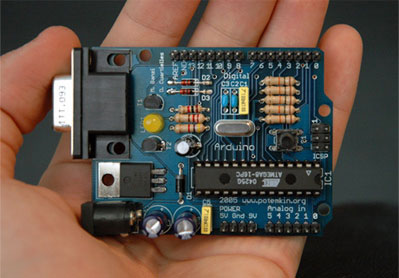
For those who do not know Arduino, here is a picture of it.
According to its website, the Arduino board:

"
is an open-source physical computing platform based on a simple i/o board, and a development environment for writing Arduino software. The Arduino programming language is an implementation of Wiring, itself built on Processing."

Despite its low price (22.00 EUR), its main quality lies on the fact that it can be expanded and controlled by a series of softwares and hardwares.

Great value for money ;)

Teoria/Theory

Different forms of Conceptual Art: Ars Systematis

1 Strategies

This project, Ars Systematis, aspires to work with “interactive metaphors” as a way of communicating by non-visual means ideas or concepts 1. Different from conceptual art per se, where concept is expressed by textual, formational or pictorial means, Ars Systematis searches for a form of interaction between observer and concept; a hermetic system where “action” leads to “reaction”. In other words, creating a different approach to the dated conceptual art and its current manifestations; an art form obsessed with avant-gardism’s and the old art for arts’ sake (Ars gratia artis).

The purpose of this art form, the conceptual art, is to communicate a concept or an idea. However, with the latest brand of avant-garde, concept is secondary to the image. Moreover, avant-garde based on the assumption that we should have our senses challenge by new forms of representation, usually defined by visual aesthetic forms, concept is not only less important than the art object, but also a gimmick (Stallabrass. 1999: p103). Consequently, we should communicate in a different way and not fall on the same repeated strategy of visual transgression.

This non-visual, but rather sensuous conceptual representation arises from some observations related to the nature of art itself 2. Despite the claims of “the end of art”, the art world, its market and its exhibitions thrive as a whole (Artprice. 2006). Yet, art and its theory seems to be for the past two decades criticized by both public and critics as a fetish and commercial activity. (Burgin. 1986; Stallabrass. 1999). Etymologically, the word “art” derives from the Latin word Ars, originally used to define ways and methods of doing and executing something. The original concept, however, is transformed during the Classical period when Ars becomes Art as a unified and hierarchical sphere that, until now, became our traditional understanding of art per se. (Rancière. 2004). Conceptual Art and some of its forms, however, seems to confront in many ways the traditional conception of art (Stallabrass. 2003). Yet, the intention of this project is not to analyze why or how art became entangled on the battle between pessimists and fetishists. Instead, we should rethink on an art form that could be representative of our current ‘information society’ (Castells. 1996).

Regarding its medium, Ars Systematis will focus on the qualities of new media. Being extremely related to our current way of production (Castells. 1996), one could even think on the possibility that new media or digital media not only relates, but is also possible by our time in history. Choices and possibilities are immense. In a practical sense, no other medium can afford the necessary interaction between idea/concept and observer (We will, later on this text, see the practicalities of this choice). Furthermore, some new media qualities implement Conceptual Art. In a comment on Manovich (2001: p226-7), Stallabrass says that:

“The break from the aesthetics of the isolated art object and the move towards an art of discursive process that was begun by Conceptual Art could be completed online where provisional, ever-changing character of material is taken for granted. As Manovich puts it in his meditation on the database form, historically, artists made unique objects in particular media in which interface and content were inseparable (and in the assimilation of Conceptual Art, we may say that they congealed) In the new media, the content of the work and the interface are separated; a work in new can be understood as the construction of an interface to a database (Stallabrass. 2003: p27)”.


2 Technicalities

Decided the medium appropriate, we should now concentrate on the practical aspect of this project. In order to achieve interactive metaphors or interactive concepts we should have an environment where an observer acts on a concept. This event is just worthy if the concept per se would react this interaction between observer and concept. As commented above on this essay, in other to escape the adversities of visual representation, we should focus on other channels of communication. In first instance, sound seems to be an appropriate form of interaction. Its availability in many digital devices and its familiarity with humans’ most basic form of communication, gives sound the advantaged in being available, familiar and non-visual.

On the simple level of interaction (action/reaction), closed, hermetic systems necessarily convert any action in reaction. Many examples of similar systems already exist, in the digital realm, and are called programs. Recently, new programming languages made possible for artists to engage with new media. Therefore, not only relying on off the shelve software but opening the possibilities for the artist own software. In its most clear examples of possibilities we have Pure Data or PD 3 and Processing 4. Those two platforms are both free of charge and the result of collaborative work. They also contain a vast library of reference for their respective software and hardware, something especially useful for inexperience users when it comes to learning their languages and procedures. In order to capture data from the observers’ interaction, we could cite a long list of examples of simple digital devices that can be connected with the artist software: Infrared sensors; ultrasound sensors; digital cameras; accelerometers; potentiometers; LDR light sensors; NTC heat sensors…Finally, its important to note that the outcome of this project is a pure experimental art form, both theoretical and methodological. We might achieve a different form of conceptualism, both in theory and practise. It might be that we have a performatic act rather than a perceptual one. Any early conclusion is mere speculative.


Notes

1 Despite the fact that many of his points could be challenged, in his ‘Sentences on Conceptual Art’, Sol LeWitt gives a clear definition between concept and idea, where ‘The former implies a general direction while the latter are the components. Ideas implement the concept.’ (1969 cited in Harrison and Wood. 1992: 850)

2 However, this project does not attempt to reconcile art and its favourite last subject, art for arts’ sake. It is clear that the quest for art sphere limits became irrelevant once all subjects are equal; a priori there is no reason for exploring different paths. This is a comment that derives from the observation of the aesthetic regime of the arts as described by Rancière (2004).

3 His developer, Miller Puckette, describes Pure Data as being

“designed to to offer an extremely unstructured environment for describing data structures and their graphical appearance. The underlying idea is to allow the user to display any kind of data he or she wants to, associating it in any way with the display (Puckette 2004).”

4 Started in 2004 by Ben Fry and Casey Reas, Processing aims to:

“teach fundamentals of computer programming within a visual context and to serve as a software sketchbook and professional production tool. Processing is developed by artists and designers as an alternative to proprietary software tools in the same domain (Processing.org. 2006)”.


Bibliography

Artprice. (2006), Art Market Trends 2005, (Internet), Artprice.com, Available from http://img1.artprice.com/pdf/Trends2005.pdf (Accessed 20 November, 2006)

Burgin, V. (1986), The end of Arts Theory, London: Macmillan Press

Castells, M. (1996), The Rise of the Network Society: The Information Age: Rise of the Network Society Vol 1, 2nd ed. London: Blackwell Publishers

Harrison and Wood. (1992), Art in Theory 1900-2000, 2nd ed. Blackwell Publishing

Manovich, L. (2001), The Language of New Media, The MIT Press

Processing. (2006), (Internet), Processing.org, Available from http://www.processing.org (Accessed 27 November, 2006)

Puckette, M. (2004), Using PD as a score language, (Internet), University of California, San Diego, Available from http://www.crca.ucsd.edu/~msp/Publications/icmc02.dir/icmc02.html (Accessed 19 November, 2006)

Rancière J. Trans Rockwill, G. (2004), The Politics of Aesthetics, London: Continuun

Stallabrass, J. (2003), Internet Art: The Online Clash of Culture and Commerce, London: Tate Publishing

Stallabrass, J. (1999), High Art Lite, London: Verso

Materiais/Materials


The Arduino playground web page has a collection of tutorials and examples of how to control its Arduino sensors with a variety of softwares. Extremely useful.

These images show the GUI and the PD object for its PD version. Arduino Playground also has a collection of links and some images for electrical work related to the physical connection of components.

Teoria/Theory

Ars Systematis

ars N 3 3 NOM S F
ars N 3 3 VOC S F
ars, artis N F [XXXAO]
skill/craft/art; trick, wile; science, knowledge; method, way; character (pl.);


systemat.is N 3 2 GEN S N
systema, systematis N N [FXXES] Medieval uncommon
system; complex whole; whole consisting of several parts; harmony (Latham)

Aims

This project aspires to work with “interactive metaphors” as a way of communicating by non-visual means. In other words, creating a different approach to the dated conceptual art; an art form obsessed with avant-gardism’s and art for arts’ sake (Ars gratia artis)

Objective

The purpose of this art form, the conceptual art, is to communicate a concept. However, with the latest brand of avant-garde, concept is secondary to the image. Moreover, traditional avant-garde is based on the assumption that we should have our senses challenge by new forms of representation, namely visual aesthetic forms. In this scenario, concept not only is less important but also a gimmick. Thus, we should communicate in a different way and not fall on the same repeated strategy of visual transgression.

Rationale

Despite the claims of “the end of art”, the art world, its market and its exhibitions thrive as a whole (Artprice 2006). Yet, art and its theory seems to be for the past two decades criticized by both public and critics as a fetish and commercial activity. (Burgin 1986; Stallabrass 1999). The intention of this project, however, is not to analyze why or how art became entangled on the battle between pessimists and fetishists. Instead, we should rethink on a art form that could be really representative of our current “Information Society” (Castells 1996)

Method

This project aspires to rethink the forms of thinking and producing art. Etymologically, art derives from the Latin word Ars, originally used to illustrate ways and methods of doing and executing something. The original concept, however, is transformed during the Classical period when Ars becomes Art as a unified and hierarchical sphere (Ranciere, Jaques 2000). Thus, we should explore this transformation (and consequently its implications for our current period) on the light of the distribution of the sensible and Rancieres’ theory of politics (Ranciere, Jaques 2000).

Outcomes

The outcome of this project is a pure experimental art form. We might achieve a different form of conceptualism, both in theory and practice. It might be that we have a performatic act rather than an object. Any early conclusion is mere speculative.

Media

PD or Processing connected to external sensors.

Materiais/Materials

This website has extremely helpful tutorials to connect many different sensors on to Arduino boards.

Its bassically prepared for processing rather than PD. However, tutorials on the same operation for PD can be found at another address.

The images shows a ultrasound sensor being connected to Arduino. This sensor emits a pulse wave that "pings" on the input of the software (PD or Processing). The closer a object is from the wave source, the quicker is the "ping"

A simple technique that could have many applications on interactive art works.

Notas/Notes

For the work (MA Forum)
The Building of Knowledge (one of Digital Arts qualities)
Construction, the music (Chico Buarque),
Relation with the aesthetic beauty of the system
and, on this specific case,
its use as critique.

In my point of view,
this beauty is the same of theories and math, physics...
The predictability and

MADA
1st Aesthetic of the System
2nd Accumulation of thought/knowledge

Think on the movie:
1-Black and White text with its translation
2-The Text being written by the hand

Knowledge/Power

Not only that work with the book is important (last post) as a metaphor of Kn/Po, but is also important by its question of arrival/path. This path, hostile and difficult, leads you to the symbolized power of the book (Think if it is a cliché - Of course it is!) and at this moment, reading the book, the hostility stops. Thus, power belongs to the individual that trespassed this path.
Yet, another question:

is knowledge independent from the "will" of the person who owns it, the oppressor?

Could be this work done by the metaphor of the closed/open book?

Open book ON (High sound)
Closed book OFF (silence)

This could be another feature of the same metaphor Kn/Po (TO THINK!)

Notas/Notes

Meeting:
+Look for Lev Manovich
+Janet H. Murray (look at her idea of immersion)
Agency Idea (relationship between observer and art piece)
+Start blogging
---------------≠---------------
Project: The long path to power

Distance "x" is inverse proportional to the sound.
Vision from the top

Approximating the object, the one that searches power will be "attacked" (sound) by knowledge. Once inside the sphere of "power" (y) the one who searches for power will have the "word".

Notas/Notes

----------------≠---------------
≠2 Scream (The same idea that I had thought before)
On PD or Processing:

A
if {voice input > 50Hz (Amp?)}
B
if {voice input < 50Hz...

Human Repealer

When someone would get at less than 5m the cornet would buzz, creating a sonic barrier aggressive to humans.
The cornet buzz is proportional to the distance between individual/object
---------------≠---------------
LCD cloth...

Materiais/Materials


Bizarre product. It may be usefully.

Notas/Notes

(continuation) For example, a individual with amnesia could explain his/her culture. Yet, not his/her personal values (?)
----------------≠-----------------
Idea: Use photosensitive and transparent paint (in powder?) to create small images that appropriate shadows made by the street objects (lamp post, garbage bean, cars - Giving preference to "statics" images?)
Static shadows would be stationary objects.

2nd Idea:
Could plants be injected or sprayed by the powder? (Aluminion something...)
---------------≠------------------
Look at the net:
Journal of Memeties
Memetics
--------------≠-------------------

Notas/Notes


Average: A sculpture of data in a 3D process:
1st Capturing data

At each new photography the software would make the transformation between different faces; combining them. However, the combination should be done with a certain delay, this way being slow and gradual.
----------------≠--------------
Theory:
Because culture "evolves" like a gene, we have the environment as the main source of transformation and adaptation. This would explain why certain "terrible" ideas proliferate on (next page) cases in which the environment changes dramatically.
The Lord of the Flies could be an example (explain,
ANALYZE AND QUESTION!
--------------≠---------------
Would be culture itself a organism?
The fact that culture is acquired by "learning" by the individual could represent the non-specialization of body cells' on the formation of the human body.
If the evolutionary culture theory is right we could draw the genealogical tree of a culture. Analyzing if the environment correspond to certain culture would explain the logic (if any) of cultural adaptation (Analyze the relation between "cultural traits" and environment).
------------≠-----------------
Art: Is it the best art piece the one that metaphorically (symbolic?) represents our culture?
-----------≠------------------
Thus, any analyzes of culture that does not concerns the agent that defines it -the
environment- is useless.
-----------≠-----------------
Could amnesia explain (next page) something?

Notas/Notes

--------------------------------
The critic (Software {1st part} and Hardware {2nd part-2D} project)

The project should be done on 2 parts.
The 1st, constitute the software. Including its full operational version on the web.
The 2nd, the Hardware, is the critic itself. This should include software (its mind) that should receive information and process it on real time.

The soft should analyze patterns between images (1) and text (2).

(1) The pictorial analyzes should include: Pixel pattern; Contrast; Colour levels; Lines (see algorithm - similar to the one on photoshop); Symmetry...

-----------≠-----------≠---------------

Good idea. However, it would take a decade!
Remember that the critic at this work is a conceptual critic. Hence, not the current critic, the metaphysical.
Another difficulty is the semantic critique. How software would recognize the "symbolic value of pixels"

Notas/Notes

(1) For the web with quicktimeVR:
The world. My bedroom in 3D. With the possibility to travel trough this world.
A VIRTUAL INSTALLATION

(2) Low Tech Technology
Create 'gadgets" that promises to be the salvation of many problems of modern life. Thus, questioning our obsession with technology

and mine,

------------≠------------

Notas/Notes


Project for the Net
We want...
(many languages)
A questionnaire to be done on the web.
Try to collect the highest number of individuals from the world.
The website becomes a collective voice of the world - a world wide ethics

Analyzing (and publishing) the data in statistic and quantitative way we would have a graphical representation (different interfaces?) of such information (which ones to publish?).
We are not interest in a dialectic interpretation of the information.

Maybe? yes because the dialectic is universal (?)
Neither we are interested in judge (the motifs and the voices) this collective voice.
The intention is to record, archive and transform this information on history. This is a never ending and continuous work. The human ambitions in a web page.

(1) How is it the questionnaire
(2)How would be done the database
(3)Should I use (or utilize) market rules (economy)?
(4)How would be the design?
(5)Open Source? Java? HTML? Mysql?

Notas/Notes

-Plain
-Text
-

IMPORTANT:
Prepare proposal for MA research
---------------------------------------
Another thing for comedy and art
1-Use Mac voices to create sitcom/podcast.
Each voice is a character
2-Use voice to narrate "Tuesday" (Tuesday V2.0)
The term "tuesday" becoming only a variable. It could be changed by anything.

27.9.06

Text/Texto: Alfonsos' Tuesday

I am a really lazy person. I always have been like that. If you are sitting on my chair now, congratulations, you might just be lazy as well. If you are not, be not afraid and sit down. And now, what are you doing in an Art Gallery anyway? Why someone would spend time and money here?

The literal meaning of art is really vague: The use of imagination to express ideas and feelings. Why express feelings? How? Why should you pay someone to express their feelings and their ideas. Don’t be lazy. You should think and feel for yourself.

Artists are not really different from you. They do not have a gift. What they do is an activity like any other. It is about technique and exercise. Like you, they have a pretty boring life. The difference is that they try to mask their reality as something much bigger than it is. Like you they pay the rent, they have dreams, they have pimples and like you they are greedy. Like everyone, they are mediocre. But please, when I am saying mediocre, do not face this as something bad.

Mediocrity is regular, average and not bad. Remember, we do not have paradigms in art anymore. Everyone can be an artist. Everything can be art. There is no “good or bad” and we cannot judge anything because everything is subjective. Thus, we could say that it is all the same. All type of art from now on will be the same. Mediocre.

It is a really big irony. Because, if all pieces of art are the same, who is deciding the “big names” of our days? Who is deciding the person who has the right to exhibit? Why should the government fund some artists and not the others? Why is Mr. Xs value more than Mr. Zs? The problem is that art has become an investment. Like the shares of a company in the future market. It is different than the old commission system. You buy a painting not to have it on your wall, not to enlighten you, neither to convert people nor to represent a point of view. Who wants to be “touched” by a painting, movie or a sculpture? Let’s be honest. We want profit! Art is status. Art dealers invest their money in art, waiting to have a profit from the sale of this artistic object. Artists are not selling their work. They are selling their shares.

Honestly, I cannot see a problem in this kind of investment, if you make money with the kings’ new clothes, good for you. What I cannot understand is why someone would trust in an investment where the rules are blurring and so vague. Looks like the Internet boom. People investing money on ideas and concepts, waiting that one-day, when it will magically bring a really big profit. So, lets stop talking about creativeness and aesthetic qualities. This is not relevant anymore. Instead, lets talk about how much this thing is worth and, please, show me the prospectus for the next ten years.

This massive plurality, in which art relies today, is just the representation of its’ end. In general, “new art “ is just recycling itself in a never-ending history. There is nothing new. You just look back to the past and pick one style, ideal and concept. The “Neo-Something”! It is easy to be plural like that. Art, as we know, cannot follow the advances of this new society. For our society, the physical medium has become ephemeral. Information now is the pillar. +Art history, like any other history, has an end.

This might be the reason why I have chosen art. I can do everything! Do questions not seem to be the forte of the new artists. For example: You randomly pick a theme. Tuesday is fine. It could be anything else. We do not have to question ourselves. Now, what have we done here? Sitting on this chair, and looking at the exhibition, can you see the irony? We have done any work and created any weird relation to this theme. Not questioning our work or ideas. Yeah! Can you feel it? Welcome to the lazy people world!

22.5.06

The Electro-Graf

According to the guys of The Graffiti Research Lab, an electro-graf is a graffiti piece or throw-up that uses conductive and magnetic paint to embed LED display electronics. The G. R . L. is dedicated to “outfitting graffiti writers, artist and protestors with open source technologies for urban communication. The goal of the G.R.L. is to technologically empower individuals to creatively alter and reclaim their surroundings from corporate visual culture in a time of aggressive, paramilitary policing tactics.”

///Honestly, I really enjoy their work. People might say that their discourse sounds like an angry revolutionary geek. However, who doesn’t sound like el Che those days? The G. R. L. is worth a visit. By the way, do you know anything similar in the UK? If yes, send me a link!

///Honestamente, eu realmente gosto do trabalho desses caras. Pode ser que alguém diga que eles soem como nerds revolucionarios estressados. No entanto, quem não soa como el Che hoje em dia? Uma visita ao G. R. L. vale à pena. Se por acaso você conhece alguém fazendo algo parecido me dá um toque!

8.5.06

Test! Teste!

New/Novo/Nuevo
is now open!